
What Is EMDR?
A gentle look at a therapy that helps the brain and body heal
In my work with clients, I often meet people who have heard of EMDR but aren’t quite sure what it actually is. They might have seen a post online, heard a friend mention it, or been told by another therapist that it could help with trauma—but it can sound a little mysterious at first.
What I love about EMDR is that, at its heart, it’s a way of helping the brain and body do what they are already wired to do: heal. EMDR helps us process what’s been too much for us to hold alone, so the past can finally feel like the past—and we can live more fully in the present. It helps the brain move through experiences that once felt overwhelming or stuck, allowing the rest of us—our body, emotions, and sense of self—to catch up to that change.
How EMDR began
In the late 1980s, psychologist Francine Shapiro made an unexpected discovery: when she moved her eyes back and forth while thinking about a distressing memory, her emotional intensity decreased. From that observation, she developed EMDR—Eye Movement Desensitization and Reprocessing—a structured therapeutic approach that uses gentle, rhythmic stimulation (like eye movements, tapping, or alternating tones) to help the brain “digest” difficult experiences that have become stuck.
Since then, EMDR has been widely researched and is now recommended by the World Health Organization, the American Psychiatric Association, and the U.S. Department of Veterans Affairs as an effective treatment for trauma and PTSD.
What happens in the brain—and body—when we’re overwhelmed
Most of the time, our brains naturally process what happens to us—integrating new information into our life story. But when something deeply distressing or traumatic happens, that process can get interrupted. The experience, and the intense emotions tied to it, can become stored in the deeper parts of the brain that don’t use language or logic—the areas that hold sensation, emotion, and implicit memory.
Even long after the event has passed, reminders can trigger the same fear, panic, or shame you felt back then. The body remembers what the mind can’t always explain. You might not recall the original event clearly, but you still feel its imprint—in your sleep, your relationships, your sense of safety, or the way your body reacts to stress.
EMDR helps us access those deeper layers that talking alone can’t always reach. Through bilateral stimulation, we invite the brain to reprocess what was too much at the time—to put a “time stamp” on the memory so that the body and brain can finally know: it’s over. The stuck material becomes connected to the broader network of experience, allowing it to be integrated and stored as something that happened in the past rather than something still being relived.
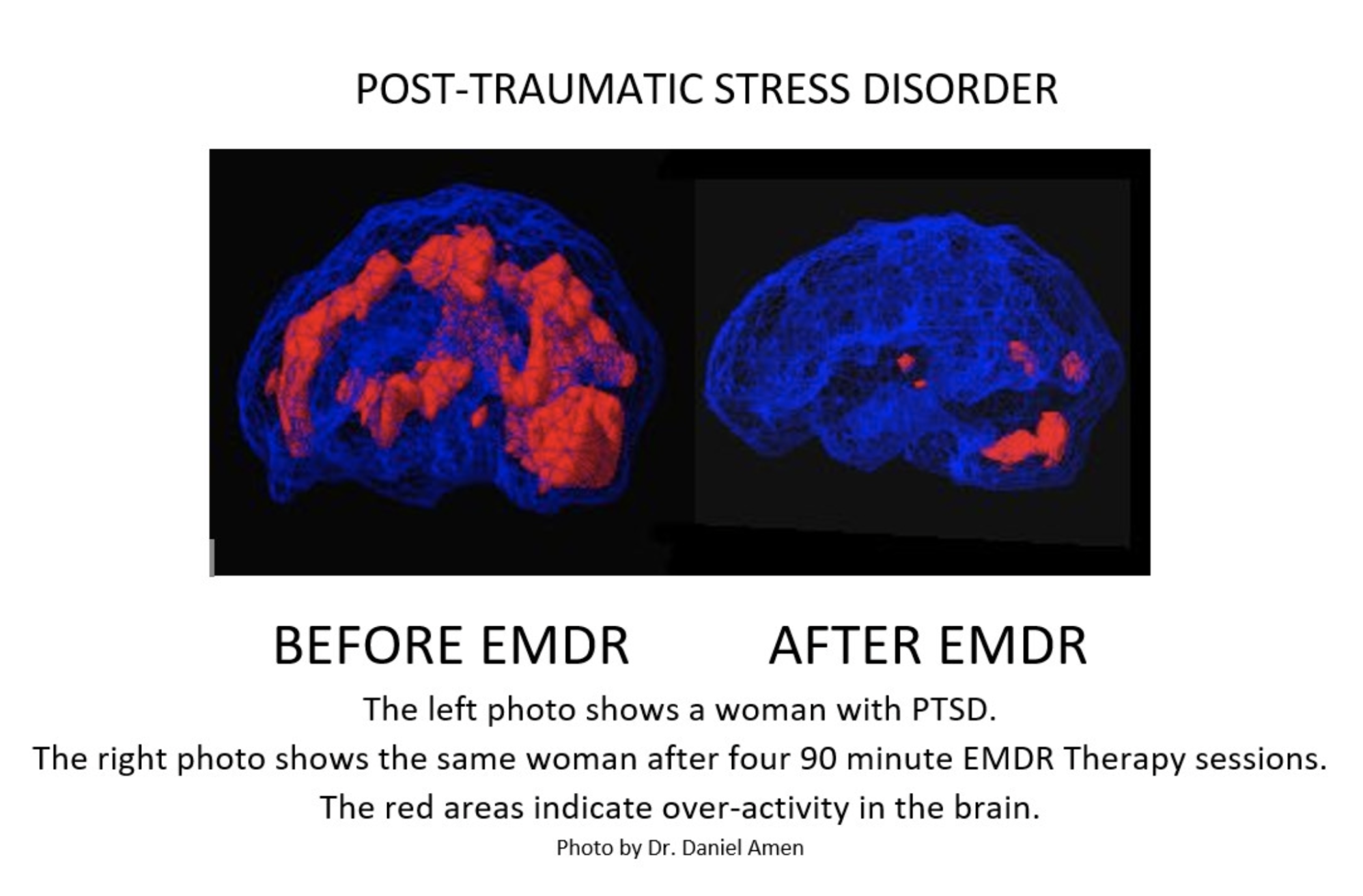
📷 Before and after EMDR brain scans (photo by Dr. Daniel Amen, Amen Clinics) show these shifts visually: the bright, overactive areas seen in trauma survivors calm after several EMDR sessions, suggesting the brain is returning to a more regulated, integrated state.
What is an EMDR session like?
EMDR works with your body’s natural healing rhythms. After a thorough assessment and preparation process, you’ll be invited to focus on a specific memory or experience that still feels charged.
Your therapist will guide you to notice the emotions, body sensations, and beliefs that arise as you hold that memory in mind, while introducing gentle, alternating stimulation—such as eye movements, tapping, or sounds. These movements are similar to what happens naturally during REM sleep, when the brain processes memories and emotions.
Each brief set of movements allows the brain to do what it couldn’t before: connect, organize, and make sense. You might notice images, thoughts, or sensations shifting. Over time, the memory loses its painful charge and feels more distant—something that happened long ago, rather than something still happening now. Many people describe this as their body finally “getting the memo” that the danger has passed.
What can EMDR help with?
Although EMDR was originally developed to treat post-traumatic stress, research and clinical experience show it can help with many other struggles, including:
Anxiety and panic attacks
Depression
Phobias and fears
Grief and loss
Addictions
Sleep problems
Chronic pain
Feelings of worthlessness or low self-esteem
Performance anxiety
Essentially, EMDR helps when parts of us are still responding as if the past is happening now. It supports the brain and body in completing what was left unfinished, restoring a sense of calm, connection, and choice.
Will I be in control?
Yes. You remain fully awake, alert, and in charge the entire time. EMDR is not hypnosis. You can pause or stop at any time. The therapist’s role is to guide and support your own natural healing process—not to direct it.
Clients often describe EMDR as a surprisingly organic experience—like something inside them finally getting to finish what it started long ago. New insights, compassion, and a sense of coherence often arise naturally as the brain and body reorganize toward greater balance.
How long does it take?
Every person’s healing pace is unique. Some people feel noticeable relief after just a few sessions, especially when working with a single, specific event. Others may work over several months, particularly when healing from long-term or complex trauma.
Sessions are typically 60 to 90 minutes and can be integrated with other therapeutic approaches, including somatic and Internal Family Systems (IFS)-informed work. These methods complement one another—helping you stay connected to your body, your inner parts, and your natural capacity to heal—while EMDR supports your brain in completing the processing that got interrupted long ago.
A closing thought
EMDR isn’t magic—but it can feel deeply transformative to finally experience relief from something that once felt immovable. Many clients describe EMDR as a way of reconnecting with themselves—their bodies, their parts, and their capacity for calm and creativity.
Healing doesn’t erase what happened, but it changes how the body holds it. And sometimes, that shift—when the brain learns that it’s over, and the rest of us finally catch up—is where life begins to feel whole again.
About the Author: Breanna Thompson is a registered therapist who integrates EMDR, somatic, and Internal Family Systems (IFS)-informed approaches to support trauma healing, embodiment, and reconnection. With a background of living and working internationally, she offers therapy to clients in Canada and abroad, helping them find safety within themselves and nurture a more compassionate relationship with their inner world.